Medical Mistrust
Healers, Heretics, and the Fight over Medicine in Germany, 1800–1914
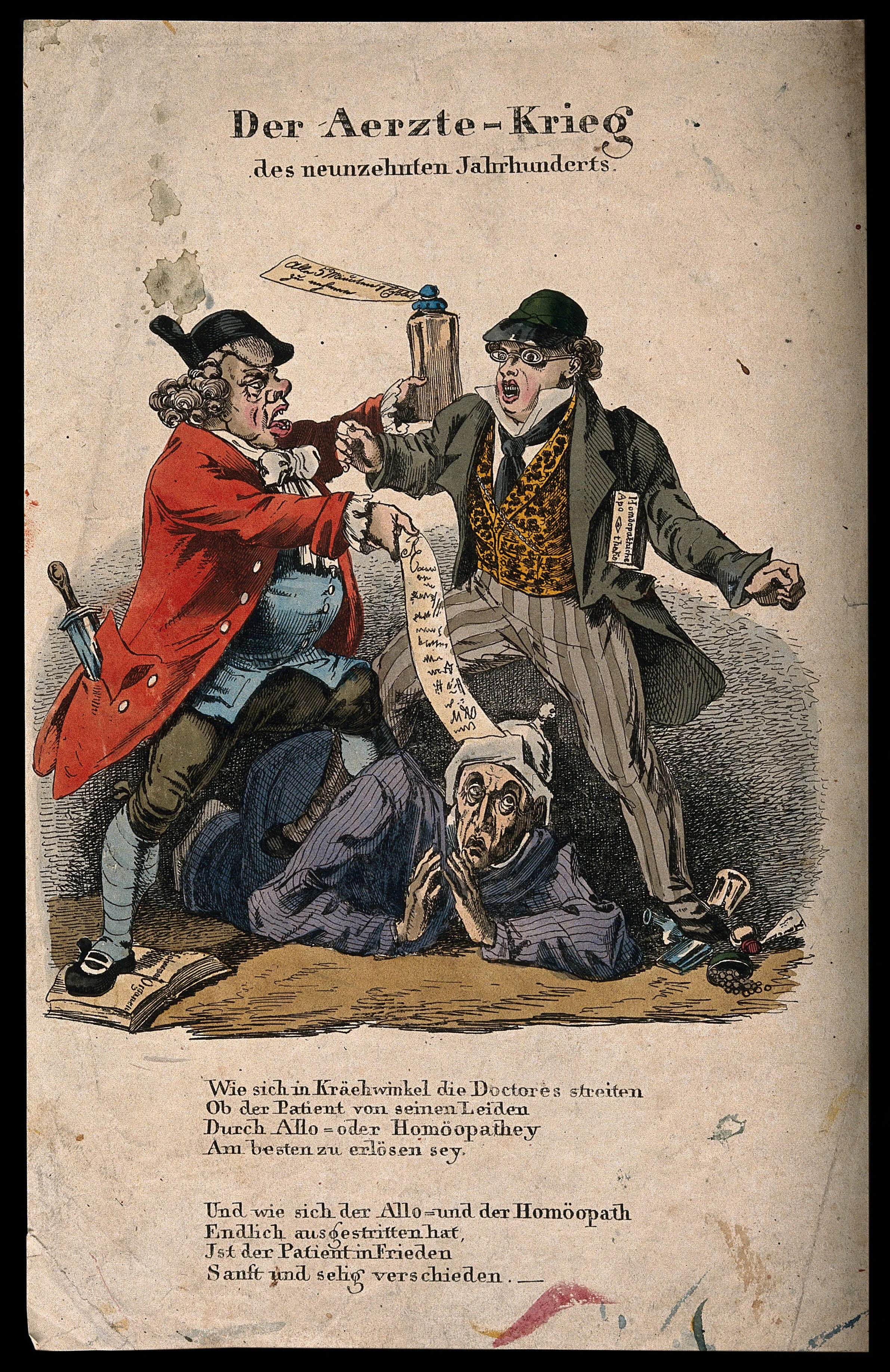
Two doctors fight over which method to use on a patient; dramatising the conflict between allopathy and homoeopathy. Coloured wood engraving. Wellcome Collection. Source: Wellcome Collection.
The rise of modern medicine provoked fierce forms of mistrust that endure to this day. Nowhere was this paradox sharper than in the German-speaking world, where doctors, scholars, and scientists pioneered bacteriology and public health even as dissenters denounced vaccines, decried clinics, and sought cures in water, spirit, or snake poison. From Dresden to Suriname, Vienna to Java, medical dissent coursed through imperial networks that made mistrust central rather than marginal to the making of modern health care.
Medical Mistrust: Healers, Heretics, and the Fight over Medicine in Germany, 1800–1914 traces this counter-tradition through seven dissident figures: a homeopath, an anti-vaccinator, a colonial doctor, a medical missionary, a feminist physician, an occultist, and a socialist naturopath. These nonconformists did not simply oppose scientific medicine. They built parallel institutions, mobilized mass movements, and articulated critiques grounded in personal injury, social exclusion, and moral concern. Yet their dissent often reproduced racial, gendered, and nationalist hierarchies. The book resists both romanticization and condescension; it probes dissent’s contradictions. Medical skepticism, I argue, emerged from the exclusions and failures of biomedical modernity itself, establishing patterns of mistrust that continue to shape contemporary health care debates.
I conducted research for the project as an Alexander von Humboldt Postdoctoral Fellow in 2016-2017. During the duration of the fellowship, I was affiliated with the Friedrich-Meinecke-Institut and the Ostasiatisches Seminar.